

A couple of days ago, somebody shamed me.
I had done something he believed I should not have done. Perhaps he had learned a particular job and was quite zealous about how it should be done and which rules should be followed. In my case, I was unfamiliar with a couple of those rules and apparently violated one that was quite important.
I "should have known better."
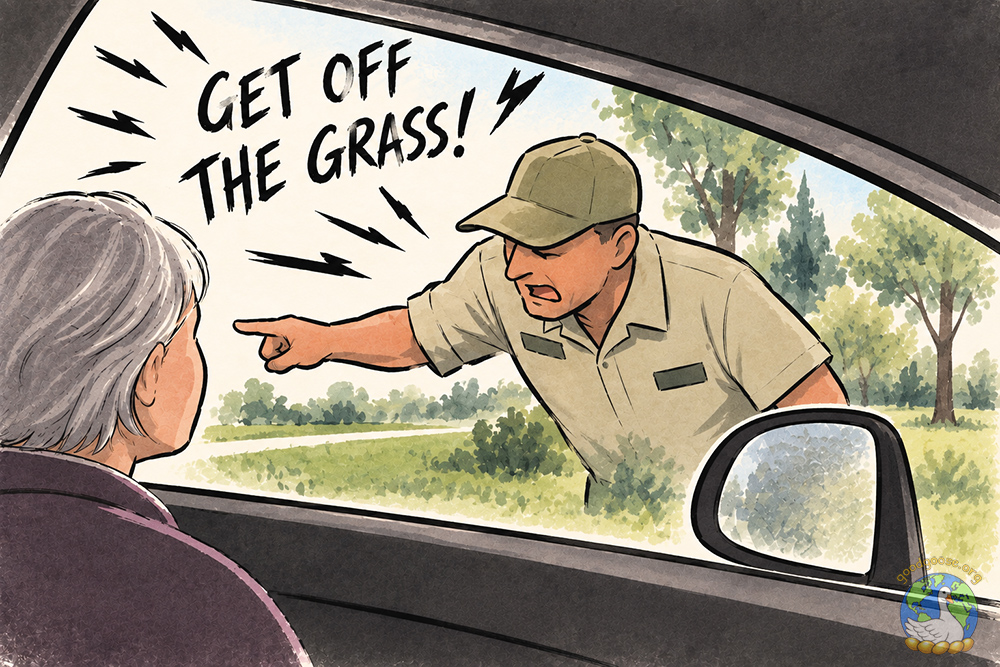
I was in a park, driving on a narrow road through a section I didn't know. When I saw a man coming toward me in an official park vehicle, I pulled over to the right to let him pass.
I was glad to see him because I couldn't figure out where I was supposed to park, and I thought he could help me.
Instead, he yelled, "Get off the grass."
I moved over and lowered my window.
"What are you doing here?" he demanded.
I told him I was looking for a place to park.
He scowled and said, "There are NO PARKING signs all over the place."
It always feels as though somebody has pummeled me in the gut when something like that happens.
And why?
I'm 80 years old. Why did I still feel bad about it 48 hours later?
Should I have known better? Was there something wrong with me? Everybody else seemed to know where they were supposed to go. They had parked where they "should" have parked.
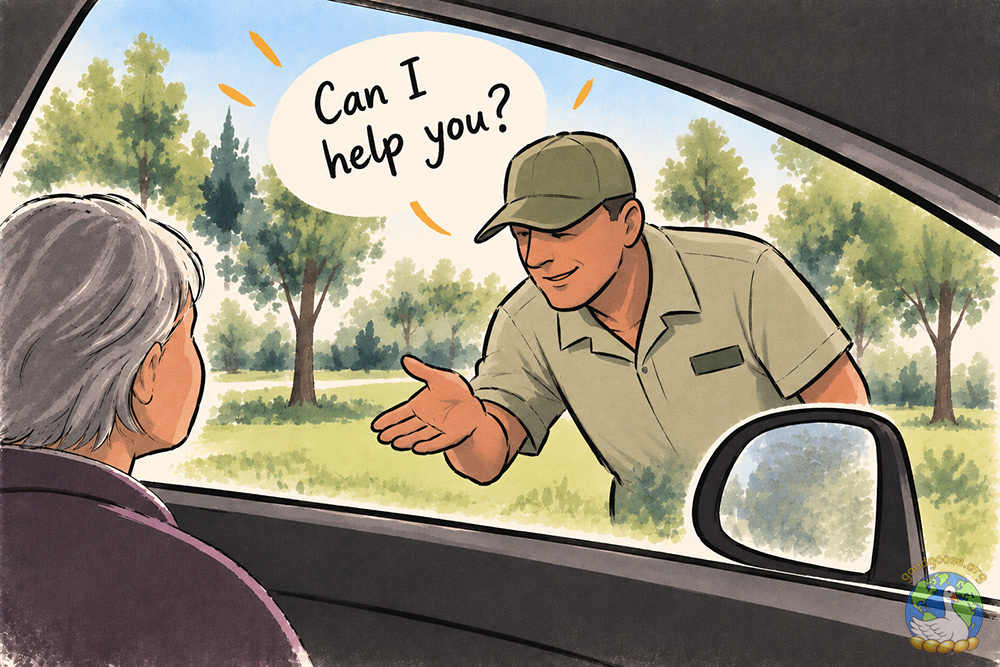
Then I started thinking about how differently those two days might have gone if he had simply said, "Can I help you?"
I would have gratefully said, "Oh, thank you. I'm trying to find a parking space. Everything back there says NO PARKING, and I thought maybe there was another parking area down this road."
He could have told me where to park and how to get there.
I would have thanked him.
And that would have been the end of it.
Instead, I felt like a shamed kid. I was upset for the rest of the day. I made more mistakes than usual, which made me feel worse, and two days later I was still thinking about it.
It doesn't really matter that I'm 80.
Stuff like this can still throw me way off.
And, of course, it happens to children all the time. And when kids, like me, feel ashamed or put down and humiliated, they don't do so well either.
After the incident, I finally found a place to park, but all during my walk I was ruminating and I was angry. I went home and journaled several pages about how that park employee had no right to speak to me that way and how I ought to call the park manager and report him. Then came all the psychological stuff—my shame, my insecurity, and all my analyzing about where those negative feelings came from.
Eventually the anger subsided.
And I was sad.
I began thinking about something much bigger than one cranky man in a park.
Kindness.
What if we took it seriously?
What if we began when children were tiny—not only teaching kindness as one more rule they were supposed to follow, but surrounding them with it?
We would comfort them. Encourage them. Help them when they made mistakes instead of humiliating them.
And as they grew, we would teach them to share and take turns and help their friends.
Be kind to your family.
Be kind to the child nobody else wants to sit beside.
Be kind to people who don't look like you.
Be kind to people who don't think like you do.
Be kind to animals.
And then—keep going.
I have been a teacher and a therapist, and I have been an HSP, highly sensitive person, all my life. I know how deeply other people affect me. And I know that we affect each other.
One human being can make another human being miserable with a few words shouted through a car window.
We can also help each other become more fully ourselves.
Maybe that is true on a much larger scale than we realize.
I've been wondering lately about children and animals.
Very young children can be extraordinarily tender toward animals. A hurt bird matters. A worm stranded on a hot sidewalk matters. A dead squirrel matters. Certainly children can also be rough or thoughtless, and no two children are alike. But I wonder whether there is an early capacity for compassion that we could nurture much more deliberately than we do.
Instead, as children grow, we teach them categories.
 This animal is a pet.
This animal is food.
This animal is wildlife.
This one is a pest.
Some animals get names and beds and toys and veterinary care. Other animals are treated in ways that might horrify the same child if they actually witnessed what happened to them.
We learn to live with those compartments about quite a few of our own species too.
Those people are wrong, bad, the enemy, going to hell, you get the idea.
But what if we didn't teach children where compassion was supposed to stop?
What if we helped them expand it?
I can't prove that suffering matters in a spiritual or cosmic sense.
I do know that pain hurts when it happens to me.
And when I see another person or an animal suffering, something inside me hurts too.
That seems worth paying attention to.
If I care about an orangutan, eventually I have to care about the forest where the orangutan lives.
If I care about a whale, I have to care about the ocean.
If I care about a monarch butterfly, I have to care about milkweed and fields and weather and migration routes.
If I care about birds and bees and frogs and elephants, I have to care about their habitats.
And if I care about children—including children who haven't been born yet—I have to care about what kind of Earth we leave them.
Kindness leads straight into forests and oceans, agriculture and pollution, biodiversity and climate.
Compassion begins to look less like sentimentality and more like ecology.
Have we have discounted something very basic in ourselves?
For thousands of years, religious and spiritual traditions have told us to love one another, care for creation and practice compassion.
What if we actually did it?
Not just toward the people we like.
Not just toward our own families or communities or countries.
Not just toward dogs and cats and the animals we've decided are lovable.
What if we kept widening the circle?
Would we be less willing to destroy a forest if we truly cared about the lives inside it? When we reported casualties of forest fires and wars, would we be thinking about all the lives lost, not just the human ones?
Would we find it harder to drop bombs if we had spent our lives practicing the habit of imagining what another being feels?
Would we take climate change more seriously if we knew the disappearing species were members of our family of life on Earth?
I don't know.
But after 80 years of living, teaching, listening, making mistakes, being hurt, hurting others, loving people and trying to understand myself, I have come to believe there is something in us worth nurturing.
Is it our capacity and potential to care?
And I don't think we need to be born into perfect kindness in order to learn it.
We can learn it later, too.
Sometimes we have to begin by learning to be kind to ourselves.
That is what finally happened to me after the incident in the park.
It took me two days.
Eventually I could say to myself:
I'm a good person. I was doing the best I could. I made a mistake. It's okay. That man wasn't kind to me. I deserved better.
And then I had to go a little further.
My spiritual practice asks something more of me than simply deciding that I was right and he was wrong.
I don't know why that man had such a hard shell that day. I don't know what has happened in his life. I don't know what pain he carries or whether he carries any at all.
But he is a member of my family of life. I can find love for him in my heart.
Maybe that's where the whole thing begins.
Not by pretending cruelty doesn't hurt.
Not by deciding that anything anybody does is okay.
But by refusing to let somebody else's lack of kindness determine the boundary of our own.
Perhaps kindness isn't merely one virtue among many.
Perhaps it is something we should take much more seriously.
Perhaps we should nurture it in children before we start teaching them all the reasons to restrict it.
Be kind to yourself.
Be kind to one another.
Be kind to the animals.
Be kind to this astonishing living Earth that all of us depend upon.
And then don't tell children where their caring should stop.
Let's find out how far it can go.